
The two alpha males of Nepali politics finally sorted out their differences, ending months of deadlock that had brought governance to a standstill.
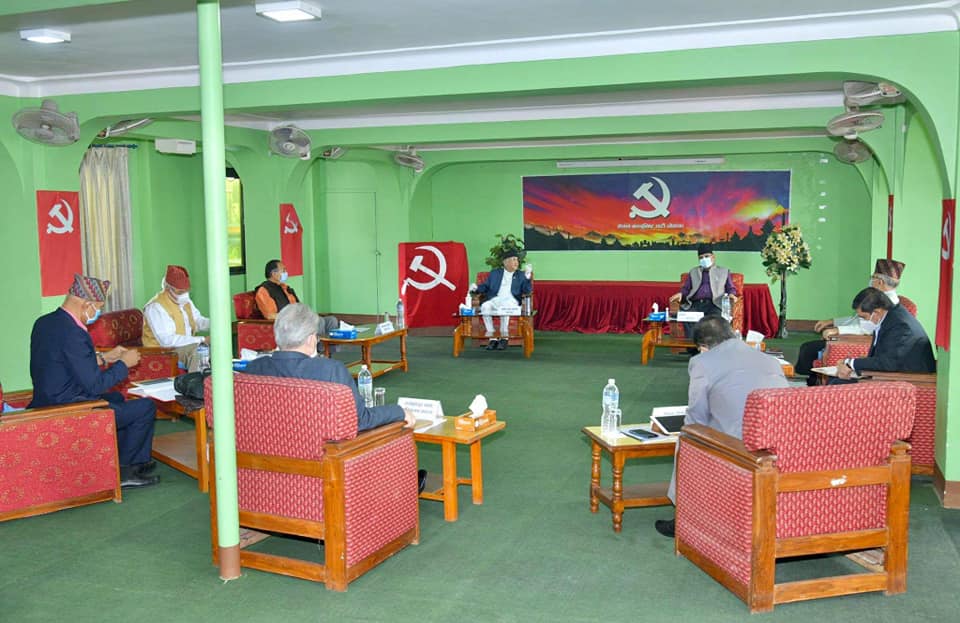
They agreed on the one-job-one-person principle, so K P Oli will serve out his term as prime minister, and Pushpa Kamal Dahal will head the party. To drive the point home, Dahal held the party secretariat meeting last week not in Baluwatar, but at Paris Danda HQ of his erstwhile Maoist party in a room festooned with hammers and sickles, and life-size busts of Marx, Lenin, Mao and Stalin. Yes, Stalin.
The senior leaders are now senior citizens, and the masked men had a hard time climbing the fire escape ladder to reach the green-carpeted third floor meeting room. The secretariat membership consists only of men, most of them Brahmin communists.
Predictably, Oli and Dahal are on the verge of falling out again over various overdue appointments to constitutional bodies, university chancellors, ambassadorships, as well as the much-anticipated reshuffle of the Cabinet. The two men are dividing up the spoils, and needless to say, most of those being considered for top jobs are men.
What an irony that after a ten-year war that was fought to drain Kathmandu’s swamp, the political calculus is the same, and the main actors are still all males from the dominant community. Corruption has now trickled up to a level where some of these appointments are reportedly ‘pre-paid’ -- offered in exchange for pounds of flesh.
This is necessary to balance the nefarious factions in the ruling party because whoever is going to be a minister now will be an incumbent during the 2022 election, and command the machinery of state during campaigning.
Over at the opposition Nepali Congress, things are not much better. Party honcho Sher Bahadur Deuba has been feuding with Ram Chandra Poudel for the better part of the past two decades, and that power struggle is still going on. Both are septuagenarians, and there is not a woman leader in sight.
The Constitution and its mandatory provisions for inclusion, quotas, and reservations have become a formality. Much more important for the ruling clique in the reshuffle, is to balance the interests of cronies, appease factions, and woo leaders from fringe parties needed to keep the two-thirds majority intact.