
|
|
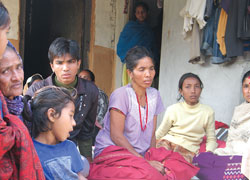
| TIME FOR TRUTH: Families like this one in Nawalparasi, whose members were victims of Maoist attacks and state atrocities, are still awaiting justice. |
Perhaps this will be the trickiest part of Nepal's peace process. Leaders of the coalition government's major partners have warned that if the proposed Truth and Reconciliation Commission (TRC) is allowed to go the way international bodies would like, the entire peace process could be disrupted.
But if it is not, human rights groups fear the peace will not last. How can Nepal get out of this catch-22? It all came to the fore with comments from international agencies following the government's first draft of the TRC last month.
They complained the document was a tool to grant a blanket amnesty even to those who had committed the most serious crimes against humanity during the 10-year conflict. (See: 'No truth, some reconciliation', #363) Their common concern is that it grants an amnesty too easily, even for the worst politically-motivated human rights violations, if the perpetrator will just indicate regret or if both parties agree to a reconciliation. Ram Chandra Poudel, who heads the Ministry of Peace and Reconstruction that released the TRC draft, says it is indeed a fiddly job.
"If we consider taking action against anyone for human rights violations, no one directly involved in the conflict will be spared," Poudel says. "In that case what would happen to the peace process?"
The CPN-M has taken the same line. Says Maoist leader Baburam Bhattarai: "We need to be mindful of whether the commission's work would hamper the peace process. Those who are making comments about the TRC don't know the reality on the ground in Nepal and they have no right to speak on behalf of the Nepali people."
But others believe these are all short-term concerns. Sandra Beidas at the Office of the United Nations High Commissioner for Human Rights (OHCHR) says it is essential to break the cycle of impunity.
"It may take time because there are many obstacles to overcome," she says. "Moreover, those responsible for violations and abuses continue to abuse because they know they will not be punished." Her boss, UN High Commissioner for Human Rights Louise Arbour, said that justice and peace are not contradictory forces.
"Justice should not be held hostage to the interest of those who threaten to resume conflict in order to avoid facing their own responsibilities," she said during her visit to Nepal in January.
Human rights activist Krishna Pahadi says those in the government have simply forgotten the pledge. "If only there is the political will, the TRC can be formed to bring the perpetrators to justice and to provide reparations to the victims."
Former home minister during the royal regime, Kamal Thapa, says he would be ready to face the TRC.