|
|
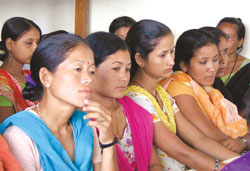
| WAR WIDOWS: Women whose husbands were killed by both the Maoists and state security sit together at a meeting of war victims in Nepalganj last month. |
Nine months after the comprehensive peace accord was signed and a year-and-half since the ceasefire, families of civilians killed or disappeared by both sides are losing hope that they will ever see justice done.
A government made up the opposing sides in the war is now setting up a Truth and Reconciliation Commission that will actually allow amnesty to those accused of committing atrocities during the 10 years of conflict.
A draft bill drawn up by the Peace and Reconstruction Ministry says in paragraph 25: "The Truth and Reconciliation Commission can recommend to the government that amnesty be given to persons who are found to have committed serious violations of human rights based on their political beliefs in the line of duty."
Peace Minister Ram Chandra Poudel defends the provision, saying the priority now is to move forward with reconciliation. "The former rebels and we are both in government...we cannot jeopardise the peace process in the name of ending impunity," Poudel told us.
Maoist ideologue Baburam Bhattarai is equally uncompromising. "At a time when the peace process is itself in danger, there is no point getting sidetracked.the (Truth and Reconciliation) Commission is not going to be able to investigate anything even if it is set up."
But human rights activists say experience from other countries show that the peace process is undermined if victims don't get justice and impunity goes unpunished. "This is called the justice of the victors, both sides want to bury their secrets," says Sushil Pyakurel, former member of National Human Rights Commission.