
Nepali Times
RABIN SUBEDI
Guest Column
Politics of aid


RABIN SUBEDI


BADRI POUDYAL
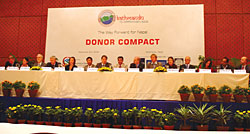
Aid has been in the news again in the past week for the wrong reasons. A consortium of Nepal-based donors held a press conference and plastered ads in the papers to warn against continued extortion of their development partners. They said this violated the Basic Operating Guidelines, but they did not dare name the political party to which the organisations that were doing the extorting belonged to.

But what of the donors' violation of Nepali regulations and their own international commitments to directly implement projects and create parallel in-country aid structures? These rules strictly restrict direct implementation of projects by donors and international aid organisations. But in Nepal, donor agencies and INGOs have been setting up offices in district headquarters and sometimes even at the local level.

This appears to be not only against the domestic laws of Nepal but also contradicts the 2005 Paris Declaration on Aid Effectiveness and the 2008 Accra Agenda for Action, which set the agenda for donor governments and agencies and recipient governments. Donors agreed to make assistance more effective by harmonising aid and channelling it through central government in developing countries. But local donor offices in Nepal are increasingly subcontracting development through an interconnected web of INGOs that undermine donors' stated commitment to 'country ownership' and 'use of country system'.

The international legal status of INGOs is being changed to Nepali legal status by registering them with CDO offices, blurring the differences between INGOs and NGOs. The real intention here appears to be not 'localisation' and 'decentralisation' per se, but capturing funding both at the national and international levels.

Most INGOs have set up their Nepal offices to tap the 'year marked' monies of bilateral donors. This has not just made aid less sustainable and increased dependency, it has also resulted in wastage, duplication and aid failure and ineffectiveness. Aid policies promoted and practiced by some of the self-described 'democratic and credible donors' in Nepal have therefore ignored and undermined Nepali ownership, which past donor compacts have committed to.

INGOs should be raising funds and tapping resources from their home countries, not from the Kathmandu country offices of donors. For their part, bilateral donors are required to use in-country systems to channel development funds. Political instability in Nepal, the lack of government oversight and weak implementation of agreed guidelines have led to this situation, which must be corrected to make aid more effective.

More than 60 per cent of Nepal's development budget comes from foreign aid, but a Finance Ministry official admitted recently that there had been no progress in enforcing international aid guidelines. Donors are also reluctant to follow their own commitments in Paris and Accra for use of country systems. The Foreign Division of the Ministry of Finance, the National Planning Commission, parliament and civil society (including the NGO Federation of Nepal) are also apathetic or ignorant about the trend.

The international agreements made by donors were aimed at making foreign aid more efficient, coordinated and effective through increased donor engagement with government agencies, parliament and civil society. It is unfortunate that what we see in Nepal today is a trend in the opposite direction.

Rabin Subedi is a campaigner with the Nepal Policy Institute, a member of the Reality of Aid Global Network.

READ ALSO:
Donor dynamics, Seira Tamang - FROM ISSUE #476 (13 NOV 2009 - 19 NOV 2009)
Wages of distortion, CK Lal - FROM ISSUE #476 (13 NOV 2009 - 19 NOV 2009)


1. ananda raj pokharel
Mr. Subedi's article is worth praising. Donor supported so called 'aid effectiveness' projects being run within Government mechanism never raise/address these issues. What they have been persistently highlighting is the weak capacity of Nepalese institutions (both government and non government) for raising aid effectiveness. But, when the roots/sources of aid are 'not effective' and 'weak' how can the recipients increase their 'capacity' or 'effectiveness'? The truth is that international actors are making developing countries their employment forum so they can't be passive supporters of the national mechanisms (institutions). Terminologies like 'technical support', 'local partners' and 'expert consultants', etc.' are used to hide their intentions for sustaining their employment in international 'labour market of development'. No need to say, our own authorities and technocrats also share the same dream.

2. Chakradhar
What is Mr. Subedi advocating? Panchayat-style Samajik Seva Samnwyaya Samiti? He seems to be arguing that if channelled through " the central apparatus of country government," aid will be used most efficiently. Maybe he needs to explain more here but Mr. Subedi has ignored the "country governments" and their ministerial and bureaucratic structures have suffered from corruption. And by the time, aid dollor reaches a village, it's skimmed off down the government hierarchy. And who are the people in the government hierarchy, Mr. Subedi should know who they are. The whole point in having NGOs and INGOs, despite all their flaws, is to get around the "country government" bureaucracy and reach to teh people directly at the local level. So, Subedi's piece sounds a bit misinformed.

3. pwlas
ngo & ingo's are nothing more than parasites who hold the country and people's plight hostage for fat salaries, shiny vehicles and foreign trips.

4. Nick Meynen
I'm from the rich north(Belgium), I'm disgusted by the lack of solidarity shown in my country towards people in Nepal who suffer from all kind of things that we have started, like climate change, but at the same time I believe that more large aid through the central government would at this point be a recepy for disaster for poor Nepali people. In my investigative report "the aid industry in Nepal", published last year, http://www.mo.be/index.php?id=63&tx_uwnews_pi2%5Bart_id%5D=21519&cHash=3df0e35453 I describe some of the structural problems of aid in Nepal, including examples such as the West-Seti dam and Melamchi. My believe is that ordinary Nepali people are better off without the multilateral aid industry but can be helped by supporting local, grass roots Nepali initiatives that do spring up everywhere in the country. If NGOs and INGOs ever want to find them and support them, they will have to go to the villages, but my hope is that they do not need a 5000 euro salarised INGO manager to do that. Or set up an office in every village. The problem with giving the government more then 60% of the budget through aid is that a wanna-be-prime minister in your country, like the current one, does not need a democratic mandate, but needs the support of the donor community. How will Nepal ever become a more just and fair society if politicians do not have to respond to the general public?

5. Sarath Guragain
HERE we go again, another juicy jibe at the romanticist foreigners' lack of common sense. Yes, we do need to rework the aid industry and especially the mechanism, especially when DFID foolishly doles out Rs 800 million to UNICEF. They will be spending 790 million of that in buying a dozen Landcruisers, and pay for parachute consultants, preferably British, with the rest. Money is going out as fast as it gets in. Why is no one raising the voice? We should all go to DFID HQ and shout at the top of our lungs for their folly. On the other hand, look at the state of Nepali NGOs and hideously corrupt self proclaimed civil society leaders. The only way is to give money to ward offices of each VDCs so that the money gets micro managed and accounted for.

6. Roshan Poudel
Mr. Chakradhar, You might be right if you want to handover everything to foreigners. The point is you need to make your system yourself not the foreigners or donors. Also you need to know very closely about the committeement of donors at internatinal level regarding the use of foreing aid and what channel they will follow. Please go through Paris Devlaration and Accra Agenda for Action. You will be clear for everything and it will convince that the donors are maiking us fool.

7. jange
Stop complaining. It's not your money that they are spending. It's theirs. They are entitled to spend it any way they like. If you disapprove, ask the Nepal government to refuse permission for the money to be spent. You are definitely entitled to do this.

8. Lok Nath Bhusal
A nice and well-argued piece. Thanks Subedi Jee for this. I would, however, take a middle position. It is sure we need aid, but only aid that serves our interests. Of course, donors give aid to aid their own interest. There is no fee lunch. If we become too stringent, donors would move to new destinations where they can relatively maximise their interests. Lets ask for aid to produce hydropower in Nepal, China is just setting the stage. No more soft aid. I request the government to adopt this policy.

9. Sarath Guragain
This is foreign aid my friends. British are calling for a round of Chevening scholarship applications . And they want to give scholarships on Human Rights, Peace, and that sort of thing. Would they ever give scholarships to study medicine, or engineering, or economics, or MBAs? No they won't. Human Rights people will enslave themselves to say what these Europeans want to hear. So, British will always keep on funding for such nonsense, irrelevant studies.

10. grass
BEGGARS ARE NOT CHOSERS

11. Sargam
The arrogance of @grass man beggars belief!?!

12. Khima Ram Lamsal
Mr. Grass I totally disagree with you. I believe that a Nepali can not make this sentence. So, you must be a person in a donors position representing any of the so called western developed country. The very simple thing is when these countries started making business in the countries like ours we have been in poverty. So, these countries are the beggars who exploit our resources and became rich. So campaign in future would be to sweep out the foreign agents and multinational companies who are working here with there malafied intention. These so called powerful rich countries can not survive even for a single day if they don't exploit poor. Keep this fact in your mind that 60 -75 percent money that has come in the name of aid has gone back to the same country (UN Study). So this is the fact........................

13. Sargam
@Khima Ram lamsal, You misinterpreted @grass's comment. It's a welknown English proverb which signifies, necessity is the mother of invention / necessity knows no law.

14. Paras Hamal
* To comment no 7 Jange.* Who are you, one of their well fed slaves? Yeah it is their money. But why all these development mantras and pretensions then? Why all these dramas about Donor Compact and all that accountability to the developing world? They should just say 'we are on holiday on our government's pay, so you Nepalese, just mind your own business'. Then we all will sit down and stop whining..

15. jange
Mr. Hamal. Nepal does not have to accept the money/aid. It is perfectly free not to accept it. Then it doesn't have to listen to any development mantras and pretensions. The choice is Nepal's.

16. Gopal Khadka
The message that mr subei is trying to convey is commendable. Actually this is what we see through our impartial lens in subedi's stuff.

17. pranab
Mr Sargam you cannot exchange your mother, motherland, nationality, sovereignty with needs and necessity. Mr Grass himself grass (Ghans), so not to waste time to comment like such a sucker.

18. bala raju nikku
congratualtions, rabin ji for an interesting piece on politics of aid. i also enjoyed reading the responses that your article raised. i would like to see the readers attention to alter the dimension a bit- from politics of aid TO politics in Nepal that need AID to perform. as a young lawyer , rabin ji might be interested in offering legal solutions to the coruption that is involved with the aid industry. or do you think that is not an issue as we cannot do any thing about it - as corruption has become a part of the psyche!! another dimension that might help ful is - is is foreign aid that is helping people of nepal or it is foreigners ( donors) who are getting aid in the name of AID?? even if they are getting much out of it - why is it happeing? academics like you and me - why are we failing in stopping this. as long as nepali citizens, and academics allow donors to do so , they continue do politics... is the ball is in our court not their court. let us act... if any of you are interested drop in for a discussion at our college where rabin ji also teaches law and social work and i am sure we will be able to find ways to bring a change ...

19. Yubak Malla
Nice and thoughtful article!

MOST POPULAR
• Who says Nepal is divided?, NEW!
• Kathmandu Spring, NEW!
•  A gathering storm, NEW!
• Identity crisis
• Truths, half-truths and damn lies

ADVERTISEMENT


Help Nepal

Tickets 2 Nepal


More ways to connect

Follow us on Twitter

LATEST ISSUE
591
(10 FEB 2012 - 16 FEB 2012)

SPECIAL
Travel Nepal

himalkhabar.com            Wave            

NEPALI TIMES IS A PUBLICATION OF HIMALMEDIA PRIVATE LIMITED | ABOUT US | ADVERTISE | SUBSCRIPTION | TERMS OF USE | CONTACT