
In 1991, India’s foreign exchange reserves almost emptied when the country’s balance of payments collapsed. The Central Bank eventually averted a full-blown crisis, but poverty in India increased in the years that followed. Manmohan Singh was finance minister, and he introduced dramatic economic reforms that unleashed India’s economy and has been the foundation of its growth.
Today, Nepal is at the risk of facing the same crisis India experienced three decades ago. There is a net outflow of foreign exchange, as remittance income fails to keep pace with the growth in imports, mainly petroleum.
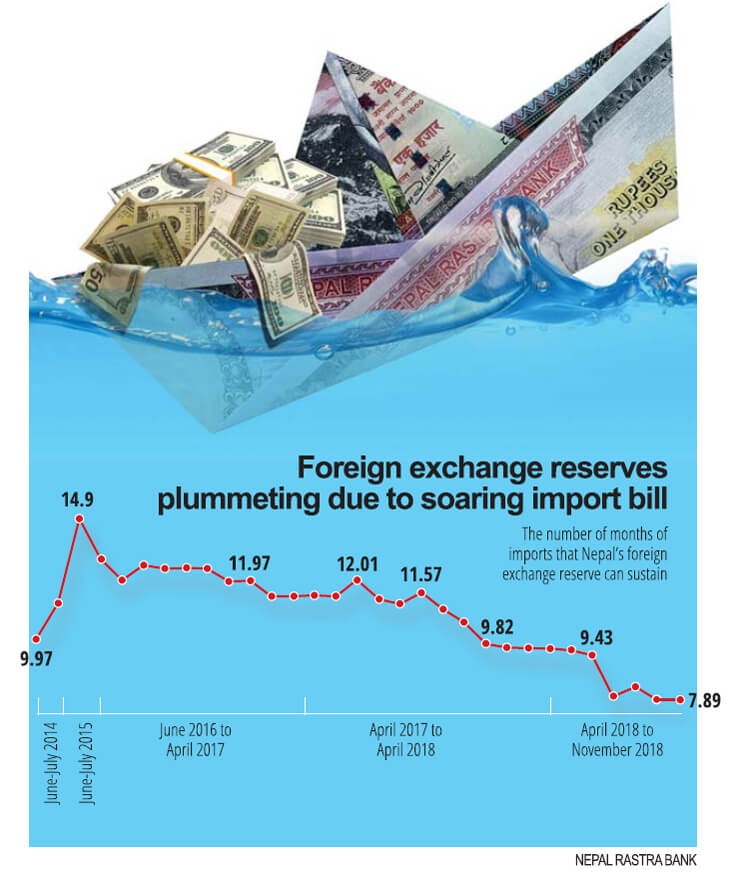
Nepal’s foreign exchange reserves currently can sustain only 7 months and 26 days of imports, compared to 14 months and 3 days as recently as 2016. (See graph above) Nepal Rastra Bank also calculated that in the first four months of the fiscal year, Nepal’s balance of payments deficit stood at Rs57 billion and in just the last month it increased by Rs22 billion.
“The current rate of increase in the balance of payments deficit will be a huge crisis in the future,” warns Bijaya Nath Bhattarai, an ex-governor of Nepal Rastra bank.
Read also : Hydrocratic dreams, Ratna Sansar Shrestha
Nepal’s over-dependence on remittance is deepening the crisis. Among different sources of foreign exchange for a country such as investments, exports, or tourism, remittances from overseas workers is the most unreliable income source because it can easily be affected by political tension and conflicts. Nepal’s remittance income is also not ploughed into productive sectors, and is mostly used up in paying for imported consumer goods and energy.
Some 65% of Nepal’s total import bill is paid through remittances, while exports constitute only 6% and investment only 17% of Nepal’s annual foreign exchange income that is used to pay for imports. But even with all these sources combined, Nepal cannot meet 12% of its import bill, which is what is leading to the balance of payment deficit. The country has been forced to dip into its foreign exchange reserves to meet the gap.
In the first four months of the current fiscal year, Nepal imported goods worth approximately Rs400 billion while exports were only worth Rs29 billion. Even though this is a tremendous difference, finance minister Yuba Raj Khatiwada admits that what worries him more is the gap in the service sector. Most of the current outflow is for energy and vehicle imports, while there is also a huge outflow due to students, medical patients and Nepalis vacationing abroad. Nepali tourists spent Rs35 billion abroad in the four months of this fiscal year, but foreign tourists spent only Rs25 billion in Nepal during the same period.