
|
|
| Yeti hunters would do better to look after endangered Himalayan bears |
An American TV crew searching for yeti footprints found some in Khumbu on 24 November, just four days into their search.
Amazingly, the Destination Truth team spotted the 12-inch footprints only half a day's walk from the airstrip at Lukla, near the lively village of Monjo and at an altitude of just 2,850m. Even more remarkable was that the find was close to Khumbu's most travelled trekking route and occurred at the end of one the busiest trekking seasons for years. It was nothing short of miraculous.
My husband Dennis and I were equally lucky. On 22 September, while enjoying a trek in Khumbu, we stumbled upon a footprint in the Renjo Khola valley. We took photographs and Dennis joked about us having discovered a yeti footprint. I laughed but I had to admit that, at an altitude of 5,100m, the remote valley just below Renjo La looked the perfect habitat for a mythical creature that for decades has successfully avoided encounters with humans. The late monsoon rain and the freshly fallen snow on the pass had kept other trekkers out of the area.
We showed the pictures to Sherpa friends and compared the shape and size of our footprint with those photographed and published by other mountaineers. We came to the conclusion that our footprint might indeed belong to a yeti.
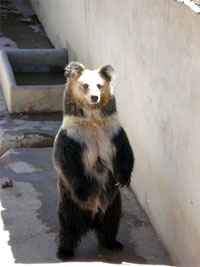
In his book, My Quest for the Yeti, Reinhold Messner suggests the legend of the yeti may be based on the existence of the chemo, a hairy Himalayan bear. Coincidentally, I went to Tibet after finding the footprint. In Lhasa I visited the zoo, the only place in the world where one can see a caged chemo.