
|
|
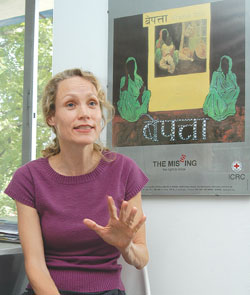
Mary Werntz, head of the International Committee of the Red Cross (ICRC) delegation to Nepal, spoke with Nepali Times about helping families find missing members and the need for a separate, independent commission on the disappeared.
Nepali Times: Is there the political will to address the issue of disappearance?
Mary Werntz: The biggest challenge is to not allow this issue and the suffering of families to be totally drawn into a political issue. It is about a basic humanitarian right. Also, unless you deal with the issue of the missing, you cannot move forward to a lasting peace.
The agreement on 8 November between theseven parties and the CPN-M to create a high level body to address this issue is extremely positive. In some countries it takes 10 years to get to that point. I've been told by the Ministry for Peace and Reconstruction that the high-level commission on the disappeared will go forward. They are very optimistic. It is essential that the commission be given the proper legal basis and be formed and function in an independent fashion. Parallel with this is the need to put into place measures to prevent further cases of disappearance.
What would be the mandate of such a commission?
The commission's mandate should be independent and humanitarian, focusing on the provision of remedies and information. It should be in contact and approachable by the families. Its first goal should be seeking to clarify the status of the missing. It should answer the question of whether someone is dead or alive, if dead the circumstances of the death and the location of the human remains. It should as well work on proper exhumation of the human remains and on identification of the recovered remains. Additionally and very importantly, it should answer to the needs of the families (material support, psychological support, etc) to help them in their mourning process.
The commission will need to collect, centralise, and process all the information with regard to the missing. This takes time. We've been working here since 1997 and have rooms full of documents which, if there is a commission we are comfortable is working properly, we'd want to hand over. The commission would also be responsible for recognising death, deciding about maybe a memorial, compensation, other legal aspects, say a woman who has lost her husband cannot hand the land down to her son because there is no way for her to prove her husband is dead.
Isn't this what a truth and reconciliation commission is supposed to do?
There's a lot of confusion about this. A high level body is mentioned only in the 8 November agreement, and is not explicitly included in the Comprehensive Peace Accord (CPA). The CPA mentions a Truth and Reconciliation Commission which can technically be a short-term body, with a mandate that could be linked with the judiciary, whereas the missing commission will function for many years to come and should have a mandate independent of judicial inquiries. The missing commission answers directly to the needs of the families of the missing people, whereas the Truth and Reconciliation Commission helps a society to come to terms with its past.
What do the families want?
We work to help families move forward. Some demand justice and push for just compensation. Others don't demand justice in the human rights sense but require recognition. Society has different opinions and certain actors in civil society have very strong opinions that may not be exactly what families think. ICRC believes the families have the right to define for themselves what they need, in order to get on with their lives.
How effective do you think the draft bill on disappearance is?
There's the draft law and existing law. Nepal is a signatory to the Geneva Convention and there are rules that are binding for Nepal. We are encouraging Nepal to sign the convention on enforced disappearance, as domestic law would have to be in line with that.