
|
|
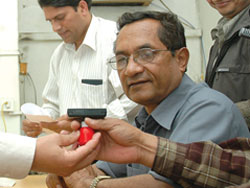
| STAMP OF APPROVAL: Maoist central committee member Dinanath Sharma at the Election Commission as the CPN-M formally registers as a political party contesting elections. |
This time last year, the people's Spring Uprising was being met with intense suppression. One year down the line the ground reality has not changed much. We see the same brash behaviour of the political leadership, the bureaucracy, the private sector. In all areas where the ruling elite have their pervasive domain, things remain the same.
Nepali society did not transform itself. As in 1950 and in 1990, the knees of the political leadership buckled in 2006 and it all ended in a compromise. History has repeated itself.
When winds of change sweep through any revolution the old order must crumble to give way to an emergent force with total control to lead the new nation. This has not happened. How can we call it a revolution if the status quo persists? Just like the Mallik Commision, the Rayamajhi Commision has been shelved. Is the military really under government control?
Another spring, another sense of foreboding as the unrest in the tarai unfolds. Hill indigenous peoples are also restive. The interim constitution has been amended, but the unrest is intensifying. The political leadership is steering the nation towards another collision.
The spirit of the April Uprising had to do with the monarchy, not re-instatement of parliament. The people were misled by the political parties on the question of republic and constituent assembly and they merged ganatantra and sambidhan sabha to make them synonymous.
The constituent assembly is an elected body to draft a new constitution. The question of monarchy must be delinked from it and addressed by a referendum. The question of monarchy is not a debatable agenda, it is a choice decided by a 'yes' or 'no'. This right to choose should be taken directly to the people so that the constituent assembly can act on that decision.