Nepal's enormous geographic, ethnic, and biological diversity throws up many opportunities for economic development, such as through hydropower, tourism, agriculture, and the like. Yet most Nepalis today remain as poor as they have been for centuries. Look at the poverty figures and you realise that a New Nepal will not come by dividing the country along the lines of ethnicity, colour or creed, but by addressing this basic inequity.
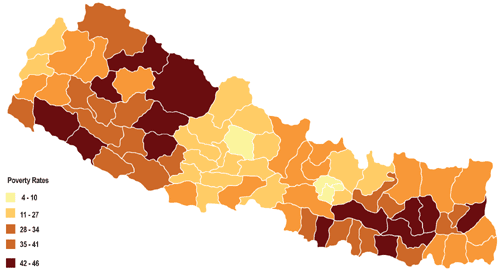
Our rugged geography and the fact that we are landlocked, our feudal practices, and Kathamandu-centric politics and policies all contribute to our misery. While it is true that Nepalis of madhesi origin have been on the receiving end of much social and economic injustice, so have many other groups not from the tarai. Of the 25 poorest districts, 16 are in the hills and the mountains and two in the eastern tarai.
Poverty mapping by using the headcount (percent of people below the poverty line) as a measure of poverty status shows that deprivation is pervasive, from east to west and includes both the 'madhesis' tarai' and 'pahades' hills'. The districts in the mid-west and the far-west spanning all ecological belts have the most people under poverty. Even the relatively prosperous eastern and central regions have pockets of poor districts in the hill and tarai regions.
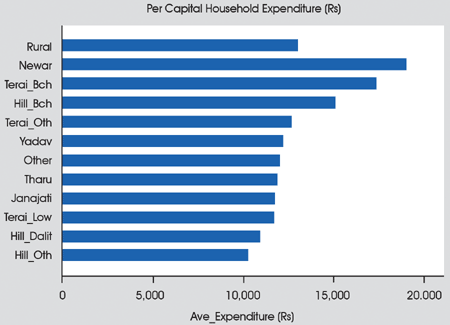
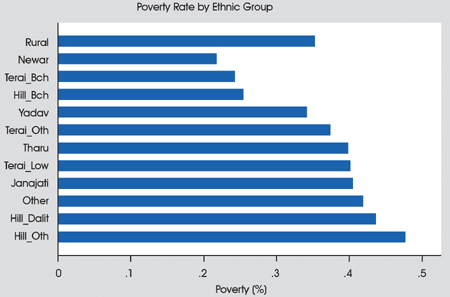
Rural Nepal accounts for 83 percent of the total population-some 19 million people. Of these, 35 percent, or seven million fall below the poverty line. The figures for per capita consumption expenditure make more sense if you also look at the disparity within each group in the bar graphs for poverty rate by ethnicity. Millions are poor and deprived regardless of their ethnicity.
In absolute terms, the vast majority of hill dalits, tharus, and lower caste madhesis (2.5 million in all) are under the poverty line. Pahade bahuns, chhetris, and janajatis each have more than a million poor. Madhesi Yadavs are doing poorly compared with madhesi bahuns.
Ethnically-clustered administrative entities are not a practical way to address the enormous socio-economic imbalances in a diverse population that has 100 ethnic groups and 80 languages. The proposed federal structure on the basis of the five pahad versus madhes regions also does not take into account comparative advantage, economy of scale, carrying capacity, or the diversity of resources. As an example, what destiny can the people of Humla, Jumla, and Rolpa chart when all they have are rugged mountains? The lumping together of, say, Rai and Magar, dalits and Sherpa, Bahun and the Chhetri would only exacerbate ethnic tensions further and prompt migration down to the plains, should hardship in the hills continue. Will the new state solve such problems by creating a culture of centrally-controlled fiscal handouts?