
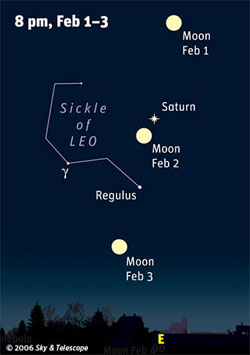
 The month's headliner is Saturn, the second largest planet in the solar system. For several months, there were no bright planets well placed in the evening sky.
The ringed planet is returning to easy visibility in February when it reaches 'opposition' on 10 February-that is, when it is located opposite the sun in the sky. When the sun sets in the west, Saturn will rise in the east. A planet is closest to the earth when in opposition, and so makes for good viewing.
Saturn is near the Sickle of Leo, which imparts an exotic aspect to this well-known asterism. Unlike dazzling Venus and Jupiter, Saturn is faint enough to be mistaken for a normal star-though it outshines nearby Regulus, Leo's brightest, by a factor of three or four.
The ringed world rises at sunset and is out all night, shining at a bright, though not dazzling, magnitude zero. Small telescopes work well to see the rings, which are more edgewise now than they have been in several years, a circumstance that makes Saturn appear only half as brilliant as in recent oppositions. When Saturn rises on the evening of 2 February, the full moon will appear close above it, and the two objects will stay close together through the night.
NASA's Cassini spacecraft is sending back some incredible pictures of swirling clouds and thunderstorms from its current trip around the Saturnian system.
Also early in February, don't miss the solar system's two inner planets at once: the elusive Mercury will be to the lower right of Venus in the twilight. As darkness falls, though, Mercury will set, so make sure you catch it early.