

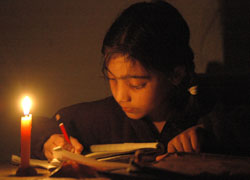
 By next year we will live in darkness for 12 hours a day. Loadshedding will certainly have a negative effect on Nepal's economy and our lifestyle. But things have not come to this pass because of some natural calamity. This is a situation of our own making, and the king's direct rule, inconsistent government policies, and bad financial decisions have only pushed us further into darkness. In addition, the unwillingness of the Nepal Electricity Authority (NEA) to purchase power from the private sector is one of the main reasons for loadshedding. The NEA is ready to buy electricity at a higher commercial rate, but doesn't trust the private sector enough to buy it from them. It seems pretty clear that the authority is not interested in Power Purchase Agreements (PPA).
Nepal's annual demand for electricity is 60MW [sic]. If the private sector can produce half, or even a quarter of this, the NEA will not have to make large investments. But instead of creating a situation where the private sector and the NEA could share the burden, the authority, which itself cannot invest because of its outstanding debts, firmly kept the private sector out of the game too. The result is the mess we have now.
The NEA's official reason for not singing PPAs is the absence of transmission lines. However, the laws state that the NEA is responsible for laying transmission lines.
Many people within the authority are always looking to bilateral and multilateral agencies and companies for investments. The NEA needs to change the perception that it is not interested in rupee investment, and can do so by issuing a whitepaper explaining the methods, models, and transmission corridors through which the electricity generated by the private sector could be purchased.
There is talk of setting up a diesel plant. If that PPA is approved, electricity could become as expensive as Rs 31 per unit. The NEA is especially interested in this plant because here it can, with local agents, procure a hefty commission.
The NEA must change its traditional, narrow attitude towards private investment. For any project, capital is the most important issue, and it can be obtained from Nepali banks and financial institutions. The NEA has to join hands with private institutions to address power scarcity.