

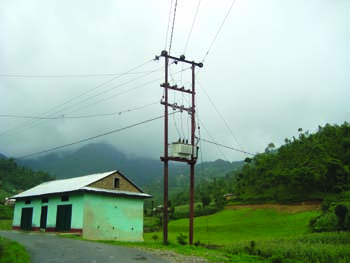
 PICS: RUBEENA MAHATO Transormer built by the Electricity Users Group in Bhardeu, South Lalitpur |
Under the community-led model, user groups partnered with the government to bring electricity to villages that were off the grid. Communities took charge of distribution, maintenance, and even shared 20 per cent of construction costs, with government providing the rest. These community-managed systems are so well administered that pilferage is non-existent and most are making decent profits. This is in stark contrast to the badly managed and nearly insolvent NEA. Following electrification under this model, schools have introduced computers, health posts have started refrigerating vaccines, and small-scale industries are being set up.
The dissolution of the department, however, has put the future of the program in jeopardy. "Consumers have invested more than Rs 750 million so far, and 93,000 households are awaiting connection. We have managed to keep the program alive but there is a great deal of uncertainty about the road ahead," says Dilli Ghimire, Chairperson of National Association of Community Electrification Users in Nepal (NACEUN).
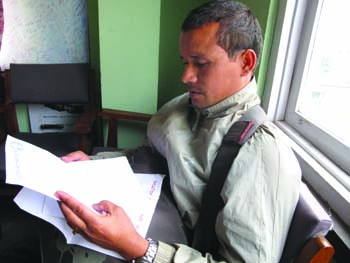 Tanka Kafle shows the financial details of his user group. 2000 member households have already submitted more than Rs 4 million to the 20-80 fund for electrification. |
Ultimately Kafle may be one of the luckier ones. Finance Minister Bharat Mohan Adhikari, who is also from Morang, has apparently promised to find him Rs 5 million. Never mind the unknown provenance of said Rs 5 million, what about other user groups who may have already invested their communities' savings?
Dilli Ghimire is indignant. "We have never faced such problems before. With the department, we could at least be sure that the consumers' money would be used where it was meant to be. NEA is so unmanageably corrupt that any program it handles is bound to fail," he says. Narayan Gyawali, General Secretary of NACEUN, is equally clear in his condemnation. "There are no two ways about it. The department was dissolved suddenly so that those in power can use the 20-80 fund for their interests. Why else would a successfully running program be interrupted?"
There may be good reason to believe this is already happening. This year, consumers deposited Rs 160 million into the 20-80 fund, which should have attracted Rs 640 million in government funding for community electrification. Since the department's dissolution, however, just Rs 310 million has been allocated. "The remaining amount will now be spent according to the whims of the ministers and officials," Ghimire says.
When asked about the allegations, joint spokesperson at the Ministry of Energy Purusottam Acharya conceded that he had no idea what transpired in the fateful meeting that terminated the department of community electrification. Secretary at the Ministry of Energy, Shital Babu Regmi, declined to comment.
Faced with crippling power cuts in the capital, it is easy to forget about the 55 per cent of rural Nepal that isn't connected to the grid. But community electrification is one of Nepal's few success stories, and high-level visits from Bhutan and Laos indicated international interest in the model. By forcibly incorporating a community-driven program into the centralised and ineffective institution that is NEA, the government is guaranteeing that its success will
be short-lived.
RELATED STORY:
Power sharing, Nepali style, #512
Making light work, #319