
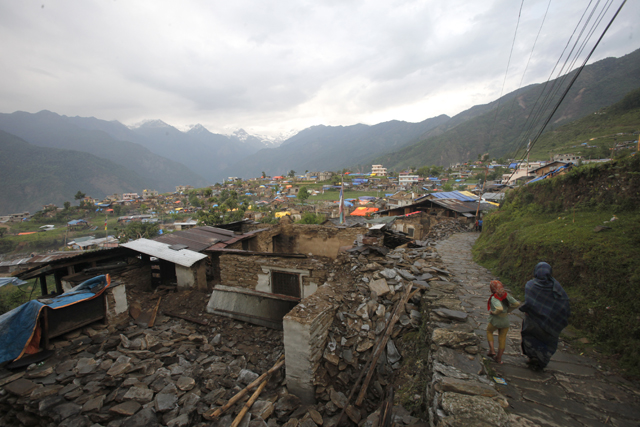
 In Barpak village of Gorkha, the epicentre of the 25 April earthquake, the locals have started rebuilding their homes on their own. Photo: Bikram Rai
Om Astha Rai and Sahina Shrestha
Nearly six months after a deadly earthquake, political aftershocks have prevented the 3 million affected people from receiving through the government the $4.1 billion pledged by the international community for rebuilding their homes.
The government formed the National Reconstruction Authority two months after the 25 April earthquake, and then on 13 August appointed Govinda Raj Pokhrel as its CEO. But parliament failed to ratify the ordinance to set it up, so Pokhrel is heading an organization that doesn’t formally exist.
"I was off to a flying start," says Pokhrel. "We had collected a strong ream and policies were being formulated. So it was a complete shock when I found out that the Reconstruction Authority was no longer a legal government entity."
Most agree that Pokhrel, who headed the National Planning Commission, was the right man for the job. He had shown to be an efficient manager who had prepared the International Conference on Nepal’s Reconstruction two months after the earthquake and finished a Post Disaster Need Assessment (PDNA) report in time for it.
But before Pokhrel set up his new office and hired staff to begin reconstruction works, the ordinance through which the authority was formed expired without being replaced by a bill. And the new bill through which the authority could have been legally institutionalised is unlikely to be passed by parliament any time soon because the UML doesn’t like Pokhrel, who is seen as an NC appointee.
To be sure, the main opposition UCPN (M) had also delayed the parliament proceedings on ratification citing provisions in the bill. But now it is the UML that is putting a spanner in the works. Parliament has forwarded the bill to its legislation committee, which will cut down the number of amendment proposals and send it back to the full house.
UML legislators say the present draft of the bill is 'very weak' and will not be strong enough to rebuild earthquake-hit areas. Most importantly, they have sought a political person as the authority's executive chief and involvement of legislators from the earthquake-affected districts.
"You cannot rebuild the country with an authority that ignores the role of elected representatives of people,” says UML legislator Sher Bahadur Tamang from the worst-affected district of Sindhupalchok. "A technocrat cannot lead a reconstruction authority, we want a political leadership."