
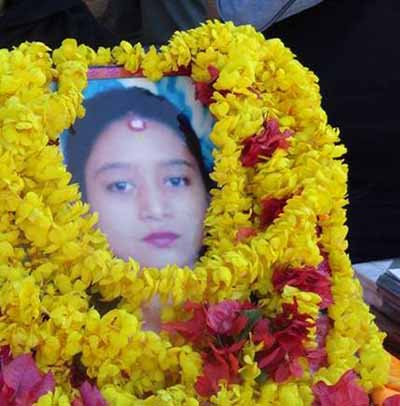
 Eleven years have passed since Maina Sunar was detained and subsequently murdered by the Army at a base in Panchkhal in Kavre.
It was exactly 11 years ago today that an army patrol detained Maina, who was just 15-year-old, for interrogation. She was suspected to be a Maoist.
It was later revealed that she was electrocuted to death on the same night. Initially, the army claimed she was killed in an encounter. But, under pressure from human rights activists, it set up a court of inquiry and concluded that she was indeed tortured and killed.
Maina's case became an iconic symbol of the human rights violations perpetrated by both sides in the decade-long conflict. Maina's mother, Devi Sunar, is still struggling to get justice ever since she lodged a complaint at the District Police Office in Dhulikhel against four army officers allegedly involved in Maina's extra-judicial killing. But, they are yet to be punished by a civilian court, and some of them are still serving in the army.
At an event to mark Maina Memorial Day in Kathmandu on Tuesday, an emotionally charged Devi said: "I have been denied justice for years, but I am not defeated yet."
Devi, who now lives with her two sons in Kathmandu, has named army officers Babi Khatri, Niranjan Basnet, Amit Pun and Sunil Adhikari as the perpetrators of Maina's murder. The army froze their promotion and detained them for some time but they are yet to be tried.
Devi also expressed dissatisfaction over formation of Truth and Reconciliation Committee (TRC), saying that it was "a waste of money".
At the program, human rights activists also flayed the government for forming transitional justice mechanisms without amending the Act on Commission on Investigation of Disappeared Persons, Truth and Reconciliation-2014 that allows the TRC to grant amnesty for perpetrators of human rights violations.
"These mechanisms don't have legitimacy," said Ram Kumar Bhandari, general secretary of Conflict Victims' Common Platform. "We don't believe these mechanisms will deliver justice."
Conflict victims have mainly objected to two provisions of the act: the amnesty provision and the decision not to criminalise forced disappearances.
"Amnesty should not be granted except with the consent of the victims," said Bhandari. "And if forced disappearances are not considered as criminal offences, how can people involved in such crimes be punished? Unless these two provisions are done away with, transitional justice mechanism will mean nothing to us."
Human rights activist Charan Prasai came down heavily on the National Human Rights Commission (NHRC) for being a mute spectator to formation of such biased transitional justice mechanisms. "We never thought that the NHRC would stop championing the cause of conflict victims," said he. "But, the NHRC has abandoned conflict victims."
Conflict victims have filed a writ petition at the Supreme Court (SC) against the controversial provisions of the act. The SC is scheduled to deliver it verdict on 26 February. "It's puzzling why the government didn't wait for the SC verdict," he said.
Members of the TRC were appointed on the basis of recommendations made by a committee that included a commissioner of the NHRC. The committee recommended people close to political parties as the TRC members, fueling speculations among conflict victims that it is just a ploy to grant amnesty to perpetrators of human rights violation.
Trying to assuage fear of conflict victims that amnesty will be granted to perpetrators of human rights violations, Prakash Wosti, a commissioner of the NHRC, said: "Let's give benefit of doubt to the TRC. If it really goes the wrong way, we'll always be there to stop it."