
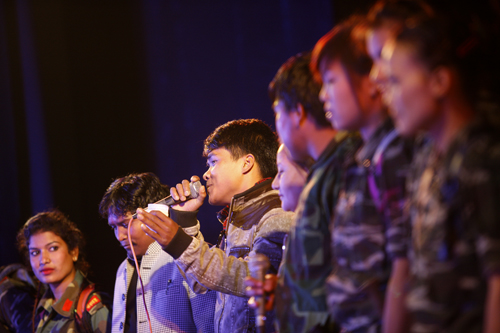
 Maoist artistes singing a song at an event held by the Chanda faction to mark their 'people's war' day in Kathmandu on Friday. Photo by Bikram Rai.
Om Astha Rai
According to the Nepali way of counting, this is the 20th anniversary of the start of the Maoist ‘people’s war’ against the state that led to the death of at least 17,000 people.
Although it is actually the 19th anniversary, the five factions of the Maoist party marked the launch of their common armed struggle on 13 February, 1996 on Friday amidst separate functions in Kathmandu. It was on this day 19 years ago that the Maoists simultaneously attacked police posts in Rolpa, Rukum and Sindhuli districts.
Back then, no one expected the war to be so prolonged and brutal. Over the next 10 years, until signing of Comprehensive Peace Agreement (CPA) with the government in 2006, the war not only killed thousands of people but also left many more injured and displaced.
For the families of 1,347 disappeared by the state security and Maoists, there hasn’t been closure even nine years after the war ended. Children born in the year the Maoist war began are now in their twenties, and are still struggling to cope with the legacy of violence and the war’s impact on the country’s development and economy.
The war is over but the political transition is not. A new constitution that is supposed to be the last stone of the peace process is still elusive. Nineteen years after launching their armed struggle, where have the Maoists arrived? And where are they heading towards?
The answer was vividly demonstrated by the observation of the anniversary by various Maoist factions.
The UCPN (Maoist) led by Pushpa Kamal Dahal and Baburam Bhattarai is still considered to be the main Maoist group that waged the war. But, prominent leaders of Maoist insurgency are no longer with them.
The Mohan Baidya-led CPN-Maoist that boycotted the second CA elections. And there is the Netra Bikram Chanda-led CPN Maoist, which is a breakaway faction of the breakaway Baidya's party. Other relatively little known leaders like Matrika Yadav and Mani Thapa have their own Maoist groups. They all celebrated their “people's war day” in different places and in different ways.
After an India-brokered 12-point agreement with parliamentary parties like the NC and the UML in November 2005, the Maoists came over-ground, joined peace process, surrendered their weapons and dismantled their 'people's army'. They rose to power after winning the first CA elections on 2008 but were restricted to a third party in the second CA.
Today, the Maoists stand divided. There are internal power struggles even within the remaining UCPN (M) and this was in full display earlier this week after Lhar Kyal Lama, a UML defector, was recommended as a CA member. Maoist leaders close to Bhattarai have stood against Dahal’s appointment of Lama.
Defeated in the last elections and unable to manage internal power struggle, UCPN (M) leaders now look desperate for a power sharing deal with the NC and the UML on the pretext of reaching a consensus on the disputed elements of the new constitution.
An aging Baidya seemingly lacks charisma, courage and confidence to establish a people's republic through what he used to call as 'an urban revolution'. He is likely to rejoin the UCPN (Maoist). Chand keeps saying he wants to launch another war but timing is not as right as it was 20 years ago.