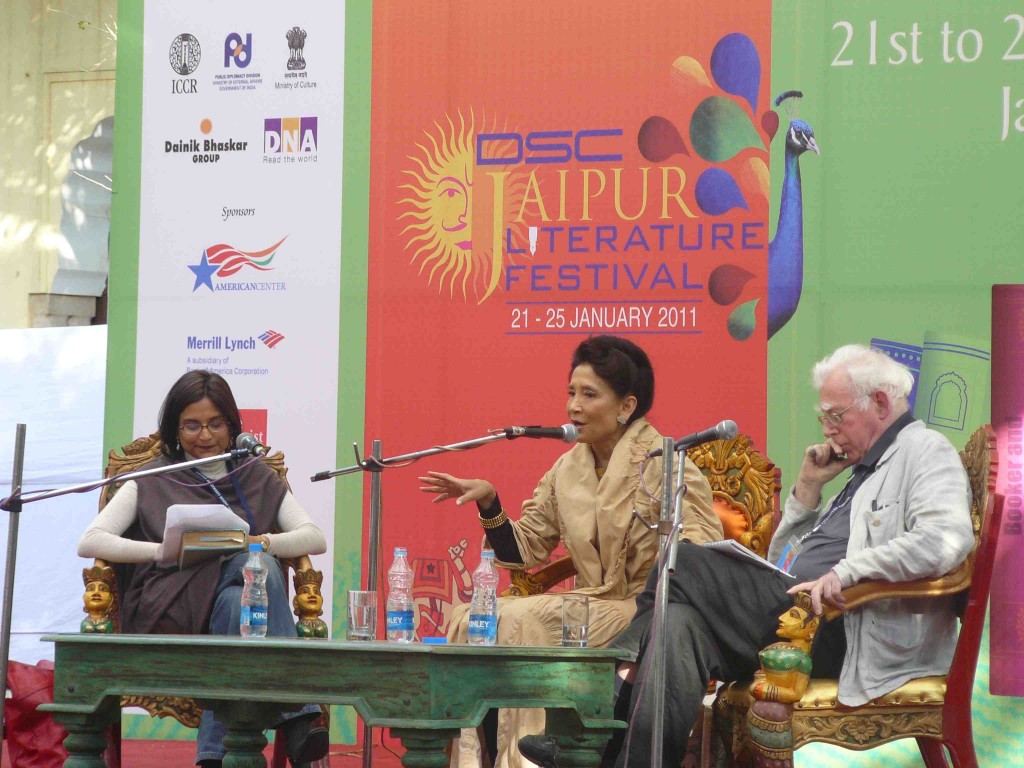

Jaipur seems bigger and more anonymous every time I return. The Jaipur Literature Festival, too, is
growing by the year, with over 100 sessions spread over four venues and five days in the sprawling grounds of the Diggi Palace Hotel. More authors, more books, more readers! And if crowd crush may be an inconvenience at sessions with marquee authors such as Orhan Pamuk, Vikram Seth, Martin Amis, Kiran Desai and Junot Diaz – with tens of thousands swarming the fest on the weekend – and if some attendees appear to care more about style than substance, the essence of such a gathering remains, to quote opening speaker Karan Singh:
“Prose is written to be read
Poetry is written to be heard”
The passion for both forms is what ties the diverse Jaipur audiences together. Shabdabrahma – the divine word – awaits you, quoth Singh, and we were ready to be beguiled.
Keynote speaker Sheldon Pollock was not one to rest on the approbation of this generalised love of literature, however. Professing to dismay at discovering that he was the only student of Old Kannada in Bangalore when he began his exploration of subcontinental classics, Pollock lamented the Silent Spring of regional languages across India. What is to be done, a question that could apply equally to the scores of languages across Nepal? What can be done not just to preserve the older, variegated forms of these ways of communicating, but to preserve our access to these “other ways of being”?
New prizes, institutions and libraries dedicated to regional languages are a way of keeping alive the hope that in 100 years, said Pollock, our railway station stands will not only stock Cineblitz and Shobha De, but also the classical languages. Because when we are lost to these other ways of being, who are we going to ask?
The gods are living in heaven
And we live on earth
Who is to say which is better, wondered Pollock:
The taste of poetry
Or the elixir of immortality?
--
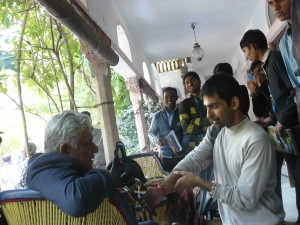
(Om Puri is following me around. When I sat down to write this on Day 2, he was right behind me, pretending to be enjoying the Rajasthani folk-rock band post-lunch. Moving on, I met the Nepali contingent – a mixture of journos, writers, and booksellers – on the Front Lawns. A heaving mass fresh from an adhoc session with Javed Akhtar and Gulzar was giving way to another mass homing into ‘Imaginary Homelands’, featuring Junot Diaz and Manjushree Thapa. I excused myself to get back to work and who takes a seat at the next table? Om Puri and his wife. A last glimpse before he was mobbed by students, doubtless staged to impress me, then it was down to brass tacks.)
So much happened on the first day. Barring the installation of an unreliable give-and-take among friends attending different sessions, there is only so much one can write about. One ends up with a fairly arbitrary thread to offer readers; the joy of such a festival is that almost everyone’s experience is unique.
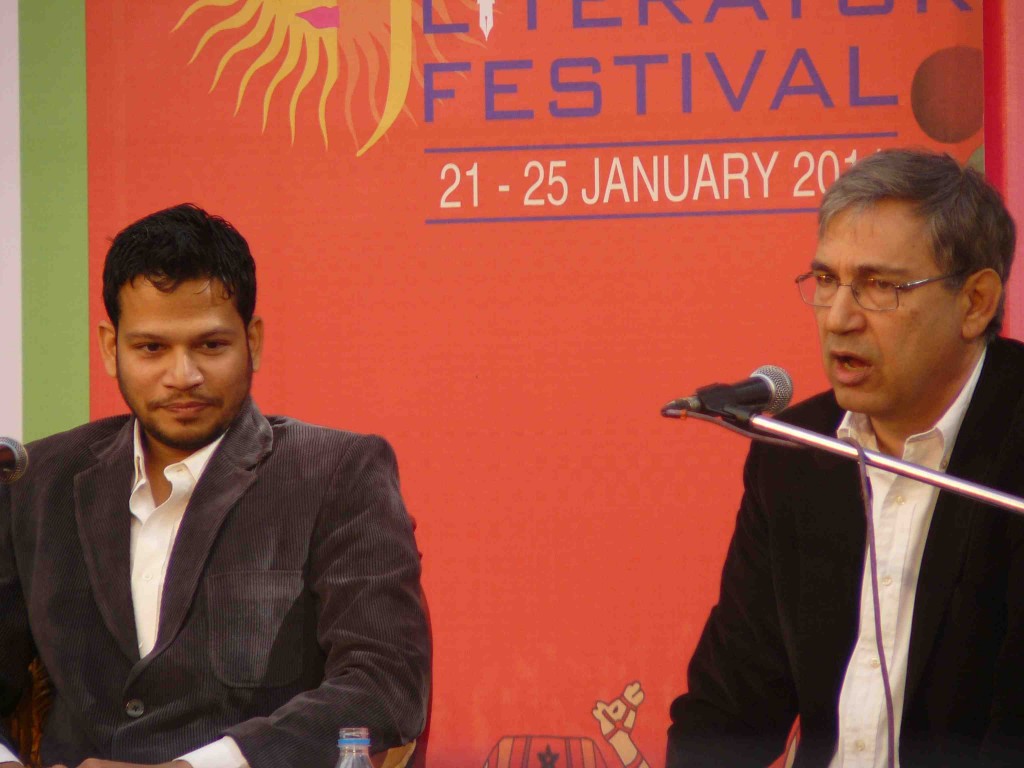
But most of the early arrivees would have turned up to hear Orhan Pamuk, author of ‘Snow’ and ‘My name is Red’, expound on the themes of cultural change in the context of Turkey. His accented, rather mechanical sounding English belied an acid, self-deprecating humour, and a very clear sense of his mission as an author. For Pamuk, it is about ‘rewriting the past in such a way that it lives on in the minds of those in the street’. The patience one would imagine necessary to recreating the milieu of medieval Ottoman miniaturists, as in ‘My name is red’, wasn’t much in evidence come question time, though. Pamuk cut short his interlocutors in the audience, and was merciless with those with only praise, no questions.
“I really like your—“
“Yes, yes. Next question!”
Does a certain genius justify eccentricity or is it the latter that underpins the former? Junot Diaz’s foul-mouthed interjections and the mantra-like references to ‘dharma’ on the part of Gurcharan Das reminded me of sulky Hanif Kureishi from last year’s edition, when he simply refused to play while quizzed on the migrant experience. The audience, as ever, loved it.
The next two sessions, on Che and Mao respectively, were rather more straightforward. What is there, after all, that we don’t know about these twin giants of 20th century communism? That one was an uncompromising hero who perished in the fire of his own ideals, the other a strategic genius whose ruthlessness laid the edifice on which modern China was built? It turns out, perhaps unsurprisingly, that there is much we still don’t know. Jon Lee Anderson’s access to Che’s widow, Aleida, guarantees insights into the man who was made a saint to further the violent causes of insurgencies across the world. But it is the painstaking research undertaken by Jung Chang (survivor of the Cultural Revolution and author of ‘Four Swans’) and her husband, Jon Halliday, that really tears into the legacy of the Mao still revered in China’s backyard.
“We knew he was bad,” intoned the elegant Chang, referring to the famine that killed 70 million and was a direct result of Mao’s policy of exporting food to buy arms, “but not that bad.” Halliday was particularly critical of Mao’s legacy (and those in western academia who still defend portions of it), dismissing the idea that Maoism was about a peasant’s revolution (“it was a military victory”), and that China’s economic growth can be attributed to Mao. “Mao is spent, there is nothing of interest in his Stalin-inspired writings,” declared Halliday. What would he think of our hidebound homegrown revolutionaries, I wondered?